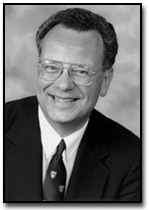
Dr. Gimbrone was born in Buffalo, New York in 1943, and received his A.B. degree in Zoology (Summa
cum laude) from Cornell University in 1965 and his M.D. degree (Magna cum laude, with Honors in a Special Field)
from Harvard Medical School in 1970. After completing an Internship at the Massachusetts General Hospital, Boston,
and a Research Fellowship at the Children's Hospital Medical Center, Boston, he served as a Staff Associate at the
National Cancer Institute in Bethesda, Maryland. He then returned to the Peter Bent Brigham Hospital in Boston for
residency training in Pathology, and subsequently rose through the academic ranks to Professor of Pathology in
1985. In 1976, he established the Vascular Pathophysiology Research Laboratory, which became the Vascular Research
Division of the Department of Pathology at the Brigham and Women's Hospital in 1985.
Dr. Gimbrone's research
focuses on the mechanisms of vascular disease, in particular the role of the endothelial cell in complex disease
processes such as atherosclerosis, thrombosis and inflammation. He was among the first to establish reproducible
methods for the in vitro culture of endothelium and smooth muscle from human blood vessels and to utilize the tools
of modern cell biology and molecular biology to dissect their functions in health and disease. His laboratory has
characterized the cytokine-activated endothelial phenotype and discovered endothelial- leukocyte adhesion molecules
important in inflammation and atherogenesis. Most recently his group has focused on the molecular mechanisms
linking biomechanical stimulation and endothelial gene regulation in atherogenesis.
Dr. Gimbrone
has published more than 250 research articles, book chapters and reviews in the field of vascular biology. He is a
recipient of an Established Investigator Award from the American Heart Association and the Warner Lambert/Parke
Davis Award in Experimental Pathology (FASEB). He is a Past-President of the American Society for Investigative
Pathology, the founding President of the North American Biology Organization (NAVBO), and has served on the Board
of Directors of FASEB, as well as various NIH study sections and national advisory committees. In 1993, he received
the Basic Research Prize from the American Heart Association; in 1994, a MERIT Award from the National Heart Lung
and Blood Institute and an unrestricted Cardiovascular Research Award from the Bristol-Myers Squibb Institute; in
1995, the Pasarow Award for Research in Cardiovascular Diseases. In 1997, he was elected to the National Academy of
Sciences, and in 1999, to the American Academy of Arts and Sciences and the Institute of Medicine of the National
Academy of Sciences. In 1999, he was a co-recipient (with Dr. Judah Folkman) of the J. Allyn Taylor International
Prize in Medicine, recognizing his contributions to the establishment of the field of Vascular Biology. He received
the Earl Benditt Lifetime Achievement Award in Vascular Biology in 2002, the King Faisal International Prize in
Medicine (Vascular Biology and Inflammation), and the Okamoto Award from the Japan Vascular Disease Research
Foundation in 2006, and the Rous-Whipple Award from the American Society for Investigative Pathology in 2008.
He currently serves as the Elsie T. Friedman Professor of Pathology at Harvard Medical School, and the Director
of the Center for Excellence in Vascular Biology at the Brigham and Women's Hospital.